Surah 4: The Women, Part 3

In The Women, Part 1 I devoted my time to examining the passages in this surah that dealt with social justice: inheritance, orphans, marriage, divorce, and general charity. Last week I looked at the passages that developed the standards of True Religion: devotion versus hypocrisy, belief in Divine Justice, doing good and avoiding sin (the worst sin being to misrepresent God), and the duty to fight oppression. That’s a lot of variety in one surah, laid out in a rather scatter plot way. Trying to prioritize information and draw thematic lines resembles solving those old math problems I hated.
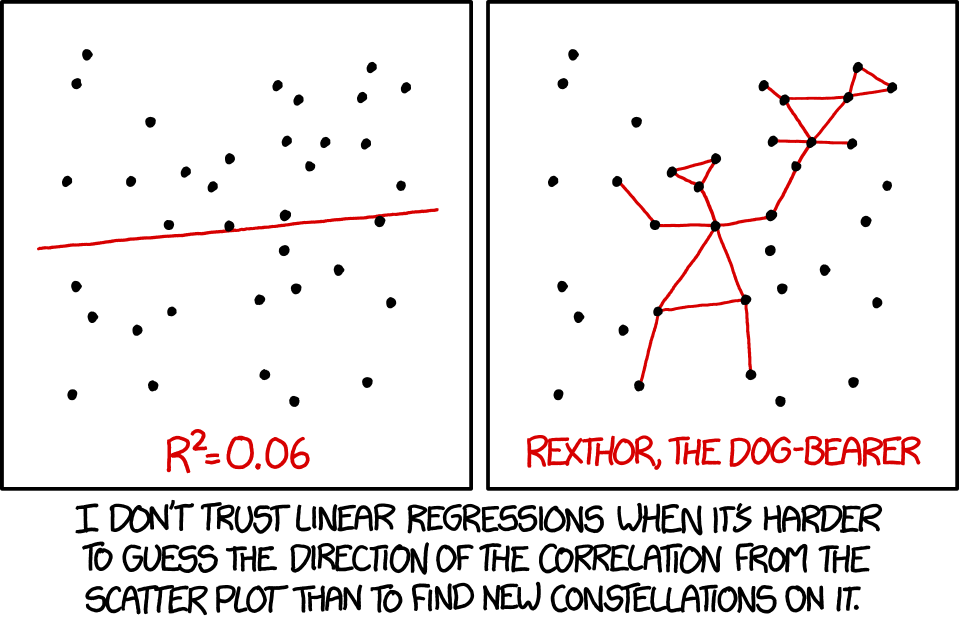
Which am I doing? Read the 176 ayat and check my work.

Organizing all the bits and pieces of information takes a long time because it’s easy to start chasing threads into circles. One topic in this surah kept popping up as important to the other ones: the centrality of Muhammad as administering prophet. I couldn’t even mention it last week as was writing without exploding the post. So I reserved to for today, sharing space with some other miscellaneous material concerning Jesus as prophet, and prophethood in general.

Continue reading “Surah 4: The Women, Part 3”
Surah 4: The Women, Part 2

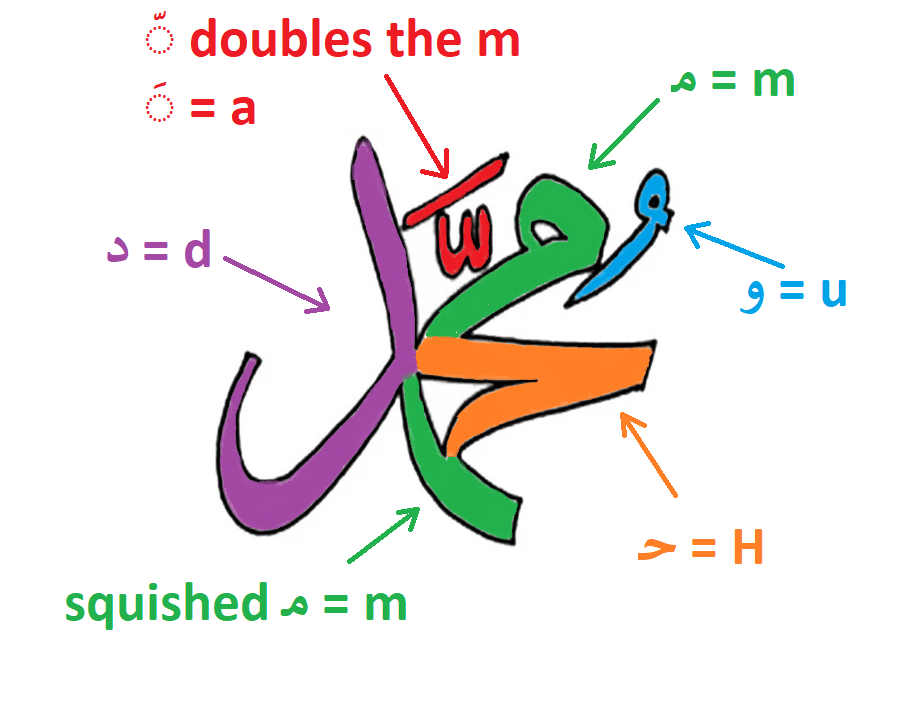
Trivia: In Arabic, most words are based off of three root consonants. The prefix “mu-” added before the roots turns the concept into a participle, like saying “one who…” Thus the roots s-l-m, which contain the concept of peace, combined with the prefix mu- combine to make muslim, or “One Who has Peace.” Those same roots are also used to form the word for “submit” or “resign” and so muslim can also mean “one who submits.” The roots H-m-d contain the concept of praise. Thus, Muhammad’s name literally means “One Who is Praised.” Although given to him at birth, Muhammad’s name would indeed describe his destined status.

Muhammad
“Muhammad” in a calligraphic form.

SSurah an-Nisa meanders through many of the same topics and phrases as the previous chapters. It establishes true religion largely by criticizing the failures of other peoples and by calling attention to the authority of God and Muhammad. The criticism part is not so targeted here, with a little attention paid towards everyone, but the most noticeable attention is paid to defining and denouncing al-munaafiquun, “the hypocrites.”

Continue reading “Surah 4: The Women, Part 2”

Surah 4: The Women, Part 1

Linguistic trivia: Arabic is a language of elisions. Vowels can elide forward into the vowel leading the next word, and consonants can elide backwards (!) replacing the consonant preceding them. Take a look at my transliteration of The Introduction and you’ll see many hyphens. Each of those hyphens represents a place where the words technically break, but the speech flows uninterrupted. The prime victim of elision is the word al (“the”). Often the A will be absorbed into the preceding vowel. The L might be replaced by the following consonant, but only if that consonant occurs on the tip of the tongue, the same place where Arabs produce their L sound. In the right setting, al can be reduced to a mere syllabic pulse. These elisions happen naturally when you talk fast, and it is now a formally understood quirk of Arabic pronunciation.

Case in point: Surah an-Nisa. It is written al-nisa, but say that fast enough with an Arabic accent and the L disappears into the N. Thus we transliterate it that way. And what does an-nisa mean?

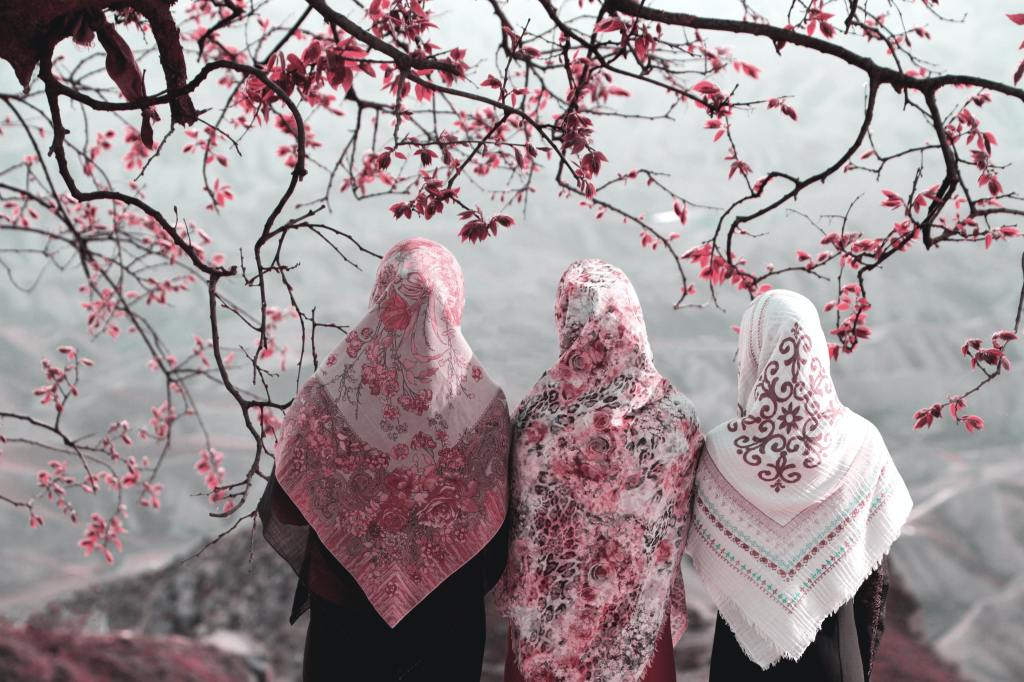
unsplash-logoHasan Almasi

“The Women”

There are two grander themes in Surah an-Nisa: social welfare and true religion. So yet again, I shall divide this surah into two analyses, consolidating messages scattered amongst the 176 ayat. Today I’ll tackle the social welfare.

Continue reading “Surah 4: The Women, Part 1”

Surah 3: Family of Imran, Part 2

Last week, we looked at the historical battles of Badr and Uhud, around which a considerable portion of this surah is focused. Yet adjacent to this battle commentary there is a long section expositing the history of Mary, naturally leading into the birth and life of Jesus (“Isa” in Arabic). The greater half of Surah al-Imran reads much like the first portion of Surah al-Baqarah. However, whereas the Al-Baqarah focused mostly on Jews, this third surah focuses mostly on Christians. The Jews were judged for rebelling against their own beliefs, but judgement against Christians seems to focus on them holding the wrong beliefs altogether. Thus, the Quran now retells Christian stories in order to convict Christians of their departure from the truth.

Continue reading “Surah 3: Family of Imran, Part 2”

Surah 3: Family of Imran, Part 1

Surah al-Baqarah ended its closing prayer with this request: “You are our protector, so give us victory over the disbelieving people,” (Sahih International, 2:286). Surah al-Imran (200 ayat long) is in many ways the manifest version of that prayer. The Muslims of Medina are starting to break into the world as a political and military force, not just a pious one, and this surah captures the dawning of this new nature. There are two events contemporary to the text that must be explained to understand its content. I’m going to step outside the text of the Quran for a moment to explain the Battles of Badr and Uhud.

Continue reading “Surah 3: Family of Imran, Part 1”

Surah 2: The Cow, Part 3

Today we are doubling down to finish Surah al-Baqarah. In part 1 we read of God’s authority as creator, and his plans for believers, unbelievers, and hypocrites (with special attention given to the failures of Jews to obey God’s law). In part 2 we examined the alternate Abrahamic heritage of Muhammad through Ishmael and religious practice centered around The Sacred Mosque at the heart of this heritage. To complete the proposed arch form, the following section should focus on the new precedent to be established by Muhammad’s students, and then continue examining God’s authority as judge and creator.

But the more I tried, the harder it was to make this arch form work with the content. I only decided this as I was examining this chart of Section C’:

As you see from his analysis, I’ve already dabbled in some topics from this proposed section and as if they were part of Section D’, oops! The Hajj/Ka’ba centrality of those passages made sense to me as counterparts to the Ka’ba narrative of Section D. But I was perhaps trying too hard to read form into the content. Compare the analysis above to proposed arcs of Section C:

So dominated by corrupt Jews and cows as it was…

There is still some similarity in theme. The message of C was that Israel couldn’t keep the law even as they were receiving it, and that of C’ is that Muslims are receiving a law which they will be able to uphold. However, if we look farther forward, we can see that the themes of B and B’ do not align at all, except by the very broadest of strokes, and the same could be said of the A and A’, which are vastly different in size and scope. So I am going to discard that arch form in today’s post. Law and obedience is by far the ruling topic to the end of the surah. To get today’s material, you might as well reread some ayat from last week, maybe starting around ayah 168, and go to the end.

Continue reading “Surah 2: The Cow, Part 3”

Surah 2: The Cow, Part 2

To put last week’s post in brief, Surah al-Baqarah (lit. The Cow’s Chapter) is structured as a palindrome (and in fact, a palindrome consisting of palindromes!). The first half is largely about the willful rebellion among men and angels, the failed covenant of Judaism, the corruptions of revelation in Christianity, and the judgement of God over all things. The middle is going to pivot on a literal turning point in Islam. After that the surah will step backwards through the themes of the first half, but this time focusing on the new direction Islam is establishing. The structure that I was using to navigate the surah is as follows:

From this source. Posting again for your reference.

Although I had originally endeavored to cover the whole first half, I found it better to stop within the content of section D. The chart above doesn’t do full justice, as this section is more about asserting the authority of Muhammad as prophet*, the legitimacy of Ishmaelites/Arabs as heirs of Abraham, and the failures of the People of the Book (Christians and Jews) to preserve and understand God’s revelation within their own history and in Muhammad’s teachings. Again, this post will probably make the most sense only if you read the entire surah, as the material is scattered and I can’t follow the themes without jumping through the whole chapter. Otherwise today I’ll cover on ayat 94-203, approximately.

Continue reading “Surah 2: The Cow, Part 2”

Surah 2: The Cow, Part 1

Oy-vay. So perhaps, like the Bible, I would not suggest reading the Quran from front to back on your first time through. Having read through the light and gentle Introduction, the reader must next face Al-Baqarah, “The Cow.” It is the longest chapter of the Quran, with 286 ayat, and in fact also contains the longest ayah, the 282nd, which fills a whole page of the Quran. Are all these words about some cow? Certainly not! But a certain cow story (or two) within the chapter is memorable enough to warrant the moniker.

But more than the size of this surah, the content is problematic for a first-time reader with limited awareness of Islam. If you are predisposed to think Islam hateful or violent, there is plenty of content to feed that suspicion. Quite a bit of the surah denounces the failures of the Jewish and Christian communities (but particularly Jewish) to live by their own covenants. Many of the passages suggest a paranoia about members within and surrounding the Islamic community. Some of the violent mandates seem history specific, but that history is not included in the text and leaves the reader confused about their application. In a way, this surah practically opens itself up for the reader who wants to quote without context, because so many things are near this state already. I had to re-read the surah multiple times in order to keep re-evaluating it and giving it a fair chance. Knowing that this surah is important to so many people…

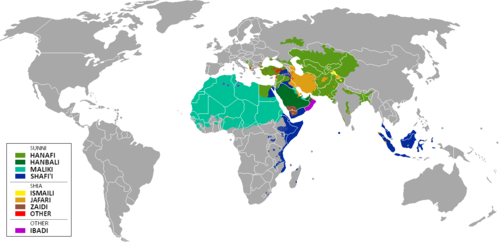
Image result for islam world map
So very many people

…I thought it was important to take the time and look with as much sympathy as I could at its intent and meaning.

Continue reading “Surah 2: The Cow, Part 1”

Surah 1: The Introduction

The first chapter of the Quran is a light and short reading, and appropriately called Al-Faatiḥa, “The Introduction.” It is a prayer and a psalm, from the speaker to God.

Screenshot_2017-07-11-15-46-20

Because this chapter is so short, I think it is easy and appropriate to give you the transliteration (my own) and translation (Sahih International):

Continue reading “Surah 1: The Introduction”

How Now to Proceed?

Firstly, I must start this post with a shame-faced admission that the resource I found most helpful when researching the structure of the Quran turned out to be…Wikipedia.

Dunce
I know, I know…

…but it was hard to use other resources for what I needed. I mostly wanted information about the Quran’s organization and literary qualities. What translations are best? How is it divided? Is there a method behind the way it is arranged? While most sites only offered pious instructions, Allahsquran.com, Wikipedia: Surah, and some scattered forums proved to be my best sources of general information. I’m sure that if I spoke Arabic properly, there would be many more quality resources available to me. As my current vocabulary only covers asking for coffee (an important life priority), it’ll be a while before I can get to them. Continue reading “How Now to Proceed?”